

Weeds sneak into gardens in surprising ways—through mulch, wind, birds, or creeping roots. Learn how to keep them out with simple edge patrols, gentle soil care, and organic weed control using vinegar-based herbicides. With top-down gardening, just a few minutes a week keeps your beds weed-free naturally.
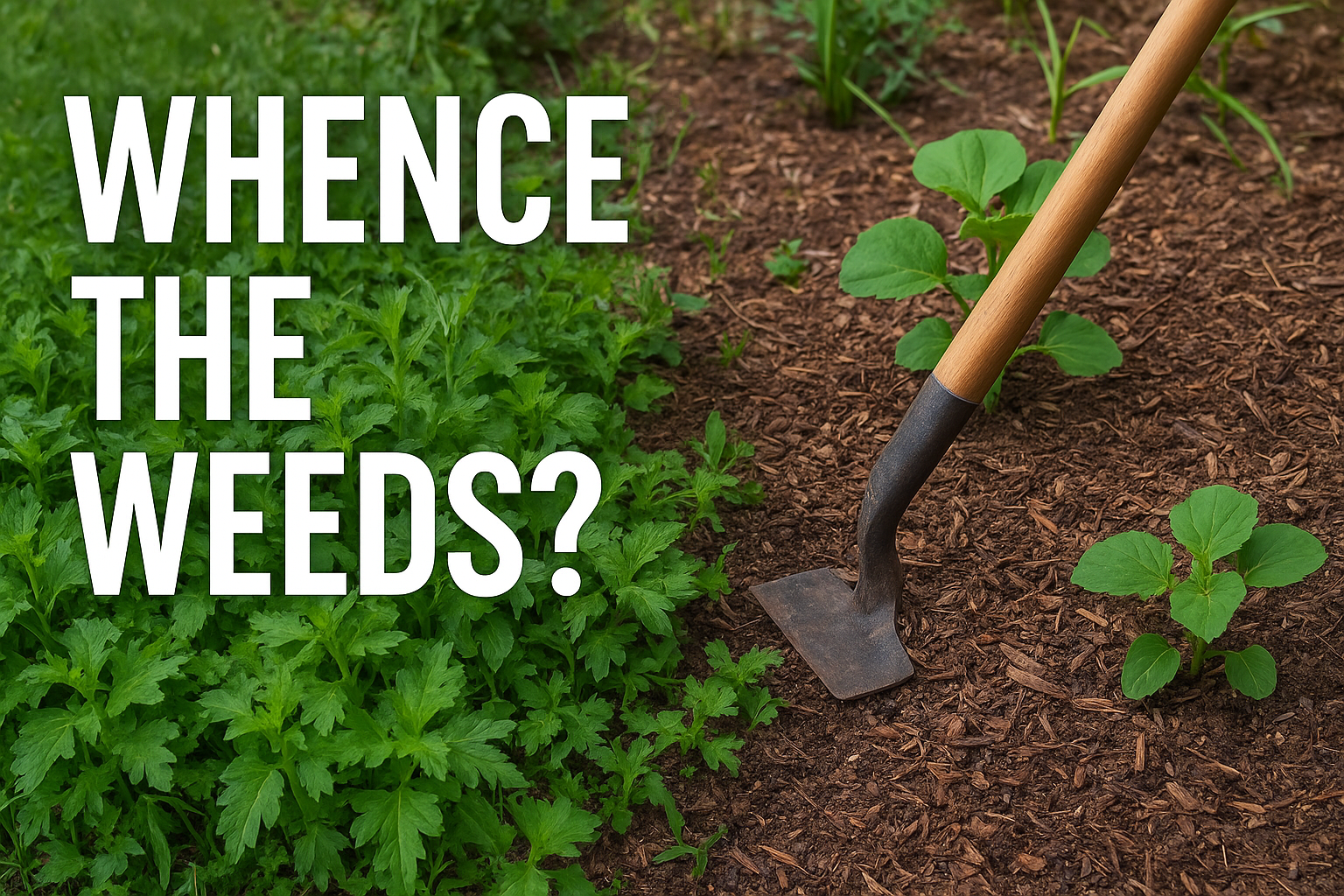
Whence the Weeds?
Initial preparation of the weedless garden left sleeping weed seeds lying undisturbed within the soil, surface weeds smothered, and the ground iced with compost, wood chips, or some other weed-free material. So where now do the weeds come from?
Look first to your “weed-free” mulch. Such material is not necessarily 100 percent weed-free. A few weed seeds might get mixed into a bale of straw and a few seeds, such as tomato, tolerate heat to emerge viable from the innards of a hot compost pile.
Weed seeds also hitchhike. Dandelion seeds are perfectly engineered to parachute into a garden with the help of wind. Wild blackberries turn up in the garden after their seeds are dropped by passing birds. Mice, water, the bottom of your shoes, and insects all have the potential to transport weed seeds.
The edge of any planted area offers another opening for weed encroachment. Here weeds might crawl in stealthily, making their way via trailing stems, as does ground ivy (a.k a. creeping Charlie) in parts of my garden, A weed ought interlope even more surreptitiously, its roots or stems pushing underground some distance, before a furtive shoot pokes above ground, In my very fist garden, the needle sharp specialized stems of quack grass traveled gust beneath the surface of the ground to eventually enmesh it in a tightening lacy network, A truckload of seaweed cured that problem, but the smell was horrendous for a while.
Weed Patrol
Edges are a good place to start regular patrol. Weedwise, take care of the edges of planted areas, and the “middies” will (almost) care for themselves. Quackgrass still relentlessly pushes its sharp underground stems through the soil in an effort to gain entry at one end of my flower bed. If I turn it away there, I rarely see it within the bed. Floppy stems of ground ivy strain incessantly into one end of my vegetable garden like the horse that strains to eat the grass just outside its fenced pasture. Once again, I keep that edge in order and rarely find ground ivy among the vegetables. Mowing bordering land also keeps weed seeds at bay.

Within a garden that has not been neglected, weeds mostly appear either as a patch of many little ones or as a few big ones. These two situations need different approaches, even though the weeds will be done in with minimal disruption of the soil in either case.
Where weeds are few just pull them up individually, roots and all, and put them into a bucket for eventual dumping on the compost pile. If pulling a weed threatens to take along enough soil to leave a crater, give the whole plant a sharp twist or use a sharp knife to slice off fine roots, leaving them behind as you pull out the stem and larger roots.
Deep-rooted weeds, such as dandelion and dock, probably will need coaxing before they’ II even budge. Force a trowel (or for a really big weed, a long, narrow-bladed shovel) into the ground alongside the weed’s taproot. Get a firm grip on the plant’s crown with one hand, then pull as you gingerly lever the plant up with the trowel or shovel. Don’t push the handle so far that you lift soil out of a newly created hole. You should be lifting the soil only slightly, keeping soil layers intact and hardly disrupting them, Once only large roots have torn free from the smaller ones, the bulk of the once glide out as the soil drops back in place.
This may seem like a lot of time to spend with individual weeds, but there are not many of them and only a few will need two-handed coaxing. Best of all, a particular weed will never come back to haunt you once pulled roots and all. Rototill a big, fat dandelion or just chop its leaves off with a hoe, and you can expect repeat performances.
Where a colony of small weed plants is invading an area, pulling individual members is too tedious—and unnecessary. The way to do in these interlopers is to cut them off just beneath the soil surface, perhaps a quarter of an inch deep. Leave the severed “plantlets” in place; they’re too small to revive and will wither within a short while.
Hoes that are perfect for this job include the colinear hoe, the hula hoe, and the winged weeder (my favorite). These tools all have sharp blades that naturally lie parallel to the ground when in use. An old steak knife with its blade bent at a right angle also does this job effectively. It is the tool conveniently hung alongside the gate to my vegetable garden—I use for occasional small patches of weeds.
Weeds rarely appear in paths, and those that do are easily pulled out. With loose materials such as gravel or wood chips, periodic raking is enough to discombobulate most weed seedlings trying to gain a foothold especially if it’s done regularly. Relatively nontoxic herbicides based on soap or vinegar are also available to kill weeds. Paths of brick, stone gravel, or other nonorganic materials call for their own weeding techniques.
Heat is effective, either with a carefully directed blowtorch (large ones are made for this purpose) or with boiling water or steam. As with any other method of weeding, all these techniques are most effectively applied to small weeds. Except for herbicide applications, use these techniques regularly—before you even see weeds.
The situation may sometimes arise where a major weeding of some part of a garden is needed. Perhaps a portion of the garden has become weedy through nothing more than neglect; or a load of compost was not really weed-free. Then there was the time when my five-year-old daughter plucked dandelions from the lawn to playfully blow their seeds about. How could I quell such exuberance (the effects of which were only appreciated by me—months, then years, later)? My advice, when more than a little weeding is called for, is to just do the job that needs to be done, slowly and thoroughly. If weeds get frighteningly out of hand, go back to laying down paper and covering it (see here).
The number of words devoted here to weeding belies the amount of time actually needed to do it. The first few years after I started gardening from the top down, I actually worried a little about how few weeds I found. I thought perhaps there was something wrong with the soil. I’ve since calmed down enough to actually enjoy the few minutes per week I now spend weeding.
An Organic, Homemade Herbicide

Vinegar—straight up, 5 or 6 percent household vinegar—is an effective herbicide spray that can be made more so by adding tablespoon per gallon of dish detergent along with 2 tablespoons per gallon of canola oil. Vinegar is a contact killer, so it is not very effective on large weeds, where upper leaves “shade” lower leaves from the spray. Also, repeat applications are needed because only leaves are killed. Root reserves will fuel new leaf growth until, with repeated spraying (weekly early in the season, then every other week, or less), roots have no more reserves. The spray is most effective at temperatures above 70°F.
