

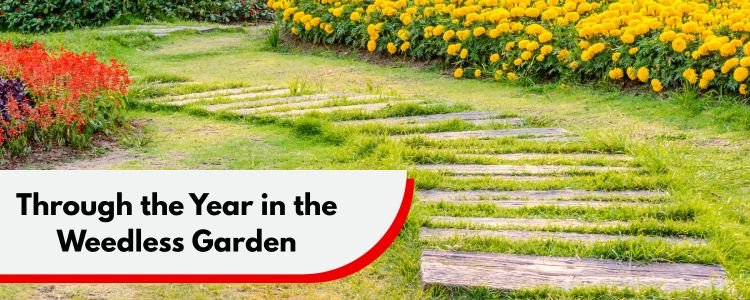
Regular maintenance goes a long way in getting the Weedless Garden to almost care for itself. What’s needed on a more or less regular basis is cleaning up and mulching—all done, of course, from the top down. At times, you might also opt to plant a cover crop to smother weeds and improve the soil. And yes, occasional light weeding is necessary.
Depending on the site, the plants, and how you garden, not all facets of Weedless Garden maintenance are needed in every garden, every year. The total time spent doing any or even all of these tasks is truly minimal—as attested to by the boredom of my daughter with her first garden when she was four years old. Once the marigolds and bush beans were planted, she tired of periodically asking,
“What should I do, Papa?”
(Besides pick beans and flowers, of course.)
My own vegetable garden—about 2,000 square feet of beds and paths—demands less than five minutes of weeding per week to keep it essentially weed-free.
Cleanup Time
Both esthetics and practicality drive us to tidy up the garden. As cheery as marigolds, cosmos, and other annuals flowers are through the summer, they have to go when blackened by frost. The vegetable garden presents a steady progression of plants that have overstayed their welcome, from old lettuces gone to seed in late spring and bush beans that have petered out by midsummer to tomato vines blackened by frost come fall. Perennial flowers also need periodic tidying, even though they return year after year.
On the practical side, removing last season’s plants is necessary to make room for next season’s plants or seeds. Once midsummer arrives and the bush beans, no longer bearing well, are out of the way, a later crop—of, say, beets or carrots—can be planted. Clearing last year’s dead marigold plants makes way for this year’s plants.
Cleaning away old or spent plants also decreases problems that result from a number of pests that survive from one season to the next on their remains. Gray mold disease of peonies, which prevents the sumptuous flower buds from opening, overwinters on old, infected peony leaves and stems. Cut them off after they die back at the end of the season, cart them away, and voila! you have put distance between the fungal spores and the new leaves they are looking to infect. The European corn borer—an insect that bores into and weakens stalks of corn and other plants—similarly spends the winter in old stalks.
In the Weedless Garden, clean up cultivated annual plants when they are no longer wanted by taking away all of their tops and their largest roots with minimal disruption of the soil. Caring for the soil from the top down promotes an abundance of shallow roots (which is good), but merely tugging up plant stalks would carry away all those roots and a goodly amount of attached soil. Roughly digging up old plants is as bad for the soil and as encouraging to weeds as tilling.
To clean up large old annual flower or vegetable plants, take a sturdy, sharp garden knife and pull up on a plant’s stalk with one hand while simultaneously working the knife up and down into the soil in a circle right around the stalk. With old lettuces or cabbages, I dispense with the knife and instead grab the head and give it a sharp twist to sever smaller roots, if a plant has some large roots running deep beneath its stalk—as some of com’s roots do—bend the stalk from side to side, thrusting the knife into the ground opposite to where the stalk is bent.

With small roots severed, most stalks lift right up out of the ground. Small roots that remain in the ground rot too fast to provide a winter home for pests, but they do enrich the soil and leave small channels for water, air, and subsequent living roots. The ground can be replanted without delay, an impossibility when ground is cleared traditionally because you then have to wait for all the debris tilled into the soil to decompose.
Clean up perennial flowers by breaking or cutting off old stalks and leaves, then carting them away. No finesse is required.
All this is not to say that any vegetable or flower garden should go into winter looking bare. Not every stalk or leaf is harboring some insect or disease ready to pounce come spring. Leaving some old plants, such as the bristly heads of coneflower and teasel, as well as the leaves and seed heads of certain ornamental grasses, dresses up the otherwise barren landscape of cold winters.
Mulch
Nature abhors bare ground and so should you. Her response to naked earth as to clothe it, a job at which many weeds excel. What Weedless Gardening does is keep the ground covered with something else, which, among other thaws, wall prevent weeds from getting a foothold. Mulch, the catch-all term for a host of different ground blankets, is the preferred alternative to bray ng soil exposed to weeds.

Why do we and Mother Nature hate bare soil? Because the naked surface is too easily blown and washed away by wind and water. Rainfall pounding on it seals pores, making it much harder for water to penetrate. This further contributes to erosion, an effect that snowballs as moving water increases speed to carve out rivulets, then gullies. Bare soil is also beat upon by sunlight, creating a hot, dry root environment.
Keeping the ground surface covered does more than keep weeds at bay and protect it from the elements. On paths, a surface covering diffuses pressure from footsteps, wheelbarrow wheels, and tractor tires. Plants aren’t growing in paths, but rainfall still must penetrate soil there and some roots of plants bordering paths find their way there. In planted beds, mulch has the additional benefit of helping enrich soil and feed plants.
Ground originally prepared for Weedless Gardening was covered with paper and topped by some other material. To maintain the garden’s surface, use the same mulch as you did when starting it. (The paper, however, was put down to quell existing vegetation and should never be needed again.)
Except for stones, bricks, and other inorganic materials that might be used for paths and rarely if ever need replenishing, all other materials used to cover the ground will be organic and do need regular renewal. Possible materials could be the same straw, wood chips, pine needles, leaves, or sawdust that you used to initially cover beds and paths, (See the Mulch Guide, here, for materials.)
With time, organic materials decompose; this is why they must be continually replenished to maintain about a L-inch depth or more over the surface. Don’t begrudge these materials for disappearing, though. As they do so, they enrich the ground with soil-building humus, release nutrients into the soil, and nourish beneficial soil microorganisms. By laying these materials on top of the ground rather than digging them in, their goodness gradually seeps in for long-lasting benefits.
How frequently mulch needs to be replenished depends on how quickly it decomposes, which, in turn, depends on the material and the climate, Hot, moist weather speeds decomposition along most rapidly, Generally, I mulch-dress my whole garden in fall because that’s when certain materials, such as leaves, are available, This also gives me less the de during the furry of spring gardening activities, and the materials have all winter to begin melding with the underlying layer of soil.
Trees, shrubs, and informal flower beds generally get a blanket of autumn leaves or wood chips (and blueberries get sawdust, which they particularly like), The vegetable garden goes into winter with a fresh dressing of wood chips on the paths and a slather of rich brown compost on each bed (except for those still carrying its late crops). At minimum, the time to replenish any mulch whether US wood chips, compost, or straw—is as soon as bare soil begins to peck through.
Malicious Mulch
Concern is sometimes voiced that spreading a nitrogen-poor mulch such as wood chips or sawdust over the soil will starve plants. The microorganisms that decompose these materials do indeed need nitrogen, and they are able to garner it at the expense of plants. But when wood chips or sawdust is laid on top of the soil, decomposition occurs mostly at the interface of the soil and the mulch—at a very slow rate. So slowly, in fact, that a steady state usually exists where nitrogen is re-released back into the soil sufficiently fast for plants growing there. These materials will surely starve plants, temporarily, when their decomposition is sped up by being thoroughly mixed into the soil.
Good Chips, Bad Chips
Each spring, stores become awash in wood chips and bark chips. Besides the usual supply available at nurseries and garden centers, clean white bags of chips are neatly stacked at the front of hardware stores, supermarkets, and even convenience stores.
Some gardeners believe that chips sold in bags are superior to those made from locally chipped trees. One fear is that termites will infest wood other than the cedar often used for bagged chips, but there’s no need for concern. Termites feed on a variety of cellulose sources, including old roots, twigs, and other materials in and on the ground; a mulch of chips would contribute insignificantly to the existing smorgasbord.
There might also he worry about diseases from locally chipped dead trees infecting the plants where the chips are spread. Again, it’s not a problem. Most fungi that attack living wood cannot survive on deadwood and would expire in the chips. Fungi are also somewhat choosy in just what they attack. Even if you spread chips from a diseased pine tree beneath your maple tree, the maple is not going to get sick unless the disease survives in dead chips and is capable of infecting maple as well as pine, and conditions are conducive to the spread of that disease. The odds of this are perhaps akin to being hit by lightning on a sunny day.
Another criticism of local chips as opposed to bagged cedar chips is that the local stuff decomposes faster. True, but some of the benefits of chips accrue only as they decompose. Local chips will need more frequent replacement, but they are relatively cheap and sometimes free.
To get a load of local wood chips, look in the Yellow Pages under “Tree Service,” or beg some from a landscaping crew working nearby. Local arborists are usually happy to unload chips at your house in lieu of hauling them to a landfill.
