

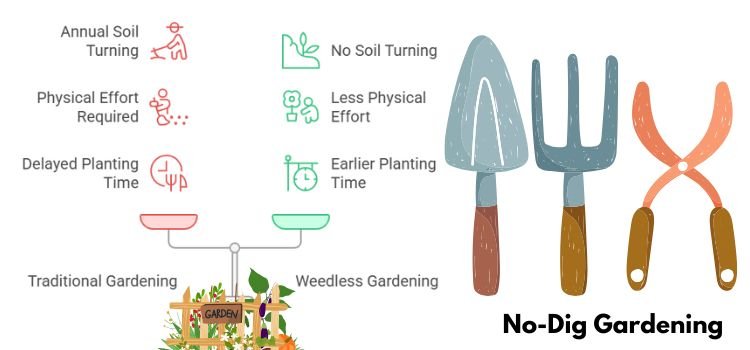
The most obvious appeal of Weedless Gardening is dispensing with the annual ritual of tuning over soil, No more wrestling a rototiller up sand down garden rows, No more making arrangements for someone to plow, Gone are the repeated thuds of your garden spade Coming up against rocks in rocky soil, Forget about needing that “iron back, with a hinge in it,” suggested as the ideal anatomy for a gardener by Charles Dudley Warner in My Summer in a Garden (1870),
Dispensing with digging also means being able to get plants and seeds into the ground sooner, One reason for digging in spring is to kill existing vegetation, be it weeds, a deliberately planted cover crop, or (for a new garden) lawn grass, ‘The digging is followed by a burst of biological activity in the soil as bacteria and fungi, fueled by a shot of air, gobble up chopped up roots, stems, and leaves, ‘This is too much commotion for seeds and small plants, so planting must be delayed for a couple of weeks until microbial activity settles down, Then another run over the ground is sometimes needed to further break up the soil and plants, causing a delay of another week or two.
Not having to dig the soil in spring also means not having to delay planting because of wet soil. Digging a wet clay soil transforms it into a compact material better suited for sculpture than plant growth. The frustration is twofold Planting is delayed until the soil is dry enough to dig, and after planting, you must wait for rain to get seeds and plants growing. Skip the digging and ail that’s needed in spring is to drop seeds or nestle plants into the ground.
Leaving soil undisturbed in spring even helps plants quench their thirst later in the season. Earthworms, roots of various dimensions, even the action of freezing and thawing all work together to create interconnecting large and small pores within which air and water move and new roots grow. Gravity quickly empties large channels of excess water, drawing air in, yet small pores of capillary dimensions cling to water against the pull of gravity. As long as these pores stay intact, water can move within them down, sideways, even up—to replace water that nearby roots drink in.
Another benefit of not turning the soil is that organic materials remain on the surface. There, they can provide a soft landing for raindrops, allowing moisture to soak in rather than run off and water your lawn or your neighbor’s garden. Organic materials at the soil’s surface also temper the effects of winter’s cold and the sun’s heat, and slow water evaporation. If you mix organic materials into the soil or bury them down deep, they cannot do their job of protecting the soil surface.
Not tilling also avoids creating a plowpan, a hardened layer within the soil that impedes drainage. Plowpans form when rototillers or plows are used at the same depth season after season, causing soil compaction just beneath the depth of tillage.
Perhaps the greatest benefit of leaving the soil undisturbed is that it preserves organic matter, including humus, the touchstone of any great garden soil. Digging, rototilling, or plowing puts such a shot of oxygen into the soil that microbial activity is stimulated to the point of burning up organic matter too rapidly. It literally disappears into thin air, most of it becoming carbon dioxide and water vapor.
It’s not that these microbes should starve. After all, plant foods are released and a healthy microbial population is supported only as organic matter is gobbled up. Problems arise, though, when organic matter is burned too fast, which happens when soils are tilled. In untilled soils topped with organic materials, the materials are consumed at a rate that doesn’t outstrip the rate at which they are replenished.
As If Once Were Not Enough

A tradition that deserves to die is that of deliberately burying organic materials in the soil to facilitate water drainage. A plow can do this, as can a strong back and a shovel, by double digging. As if one digging were not enough, double-digging entails digging out a trench, mixing organic materials in the bottom of that trench, then turning over adjacent soil into the trench—thus creating another trench that is treated the same way. And so on across the garden. Burying organic materials is not only a waste of time, but the effect is actually the opposite of what is intended. A water table (or perched water table) actually develops atop the drastic change in soil porosity created by the wad of buried organic materials.
